02 / 04
Population-level planet statistics
Demographics
A single discovery tells you that a planet exists. A population tells you how planets are made. Just as a census reveals patterns no single household could, counting how often different kinds of planets appear around different kinds of stars lets us test our ideas about planet formation. I use large, carefully controlled surveys to make those inferences.
Where giant planets end and brown dwarfs begin
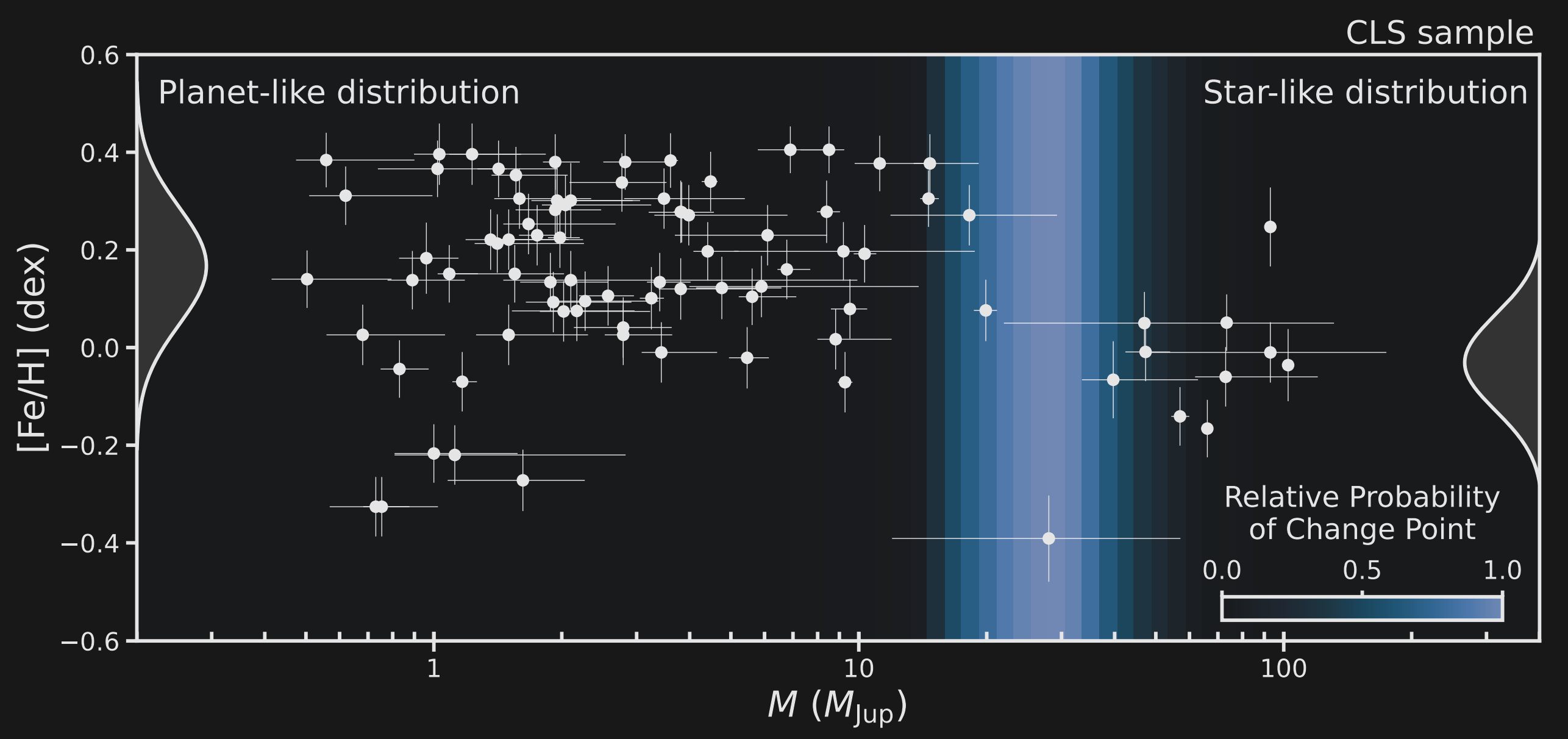
There are two ways to build a giant object around a star. In the bottom-up route, a rocky core grows first and then sweeps up gas, the way Jupiter is thought to have formed. In the top-down route, a clump of gas collapses under its own gravity, the way stars form. The bottom-up route needs plenty of solid material, so it works best around stars rich in heavy elements (astronomers call this metallicity). The top-down route barely cares.
That makes a star's metallicity a fingerprint of how its companion formed. Using the California Legacy Survey, a 30-year search that found hundreds of planets and brown dwarfs, I found that companions lighter than about 27 Jupiter masses tend to orbit metal-rich stars, while heavier ones do not. That puts the dividing line between "planet-like" and "star-like" formation well above the 13 Jupiter masses traditionally used to separate planets from brown dwarfs (Giacalone et al. 2026).
Why hot stars have fewer small planets
A-type stars are hotter than the Sun and about twice its size. Planets around them are hard to find, so earlier missions such as Kepler largely skipped them. NASA's TESS mission, which watches nearly the whole sky, finally made a proper census possible. For my PhD thesis I searched more than 20,000 of these stars and made the first measurement of how often small, close-in planets orbit them. The answer: rarely. Planets a few times the size of Earth may be more than six times less common around A-type stars than around stars like the Sun (Giacalone & Dressing 2025). This rarity can be explained if planet migration through the protoplanetary disk halts at the dust sublimation radius, which is larger for hotter stars (see animation below).
Sun-like star
Hot A-type star
Papers
-
The Astronomical Journal, 171, 75 (2026)
-
Small and Close-in Planets are Uncommon Around A-type Stars
The Astronomical Journal, 169, 45 (2025)